Balancing Ethical Use & Reframing the AI Conversation
Learn how to mitigate clinical risk while developing essential AI literacy competencies.
June 11, 2026
Welcome to SLPs Talk Tech, where speech-language pathologists and allied professionals get updates, insights, and practical strategies on how AI and emerging technologies are shaping research, clinical practice, and support for individuals with communication disorders. We spotlight innovations, AI tools, and strategies that address real challenges faced by SLPs and their colleagues.
Now, on to the post…
The AI conversation is polarized between two extremes: a utopian view of AI as the ultimate optimization tool, and the fear of surveillance, environmental destruction, and loss of privacy. The opportunities to use AI continue to pop up seemingly everywhere, resulting in the need to focus on treating AI as an “augmentative” tool. For SLPs, we understand the difference between “augmentative” and “alternative”. Whether you are using AI to modify a final product or trying to streamline the therapy planning process, you are applying clinical logic. Your human oversight is essential and ensures technology serves the client’s autonomy, not the other way around. In this newsletter, we’re touching on two themes: Balancing efficiency with ethical AI use and reframing the AI conversation.
How can we balance efficiency with ethical and clinical responsibility?
First, we must be realistic about AI flaws, harms and risks. To use AI responsibly, here are some traps to watch out for:
Data Trap: Clinicians must exercise caution when inputting information (data) into general-purpose LLMs. Never risk your client’s protected health information (PHI). Without verified, HIPAA-compliant data processing agreements, you risk that data being used as training data or sold to third parties for a profit. We are obligated to protect our patient’s information.
Algorithmic Bias Trap: General purpose AI models (i.e., Gemini and ChatGPT) are trained on vast swaths of internet data, not vetted libraries of clinical research. If we don’t critically evaluate the cultural and age-appropriate relevance of AI-generated materials, we risk imposing the technologies’ bias on our clients.
Hallucinations Trap: Generative AI models are designed to provide an answer even when they lack the correct information, often presenting false information with alarming confidence. For the average user, unpacking these errors and the hallucination rates of various AI models is difficult. To avoid this trap, clinicians should treat AI output with healthy skepticism and critical analysis, cross-referencing AI-generated content against verified clinical literature.
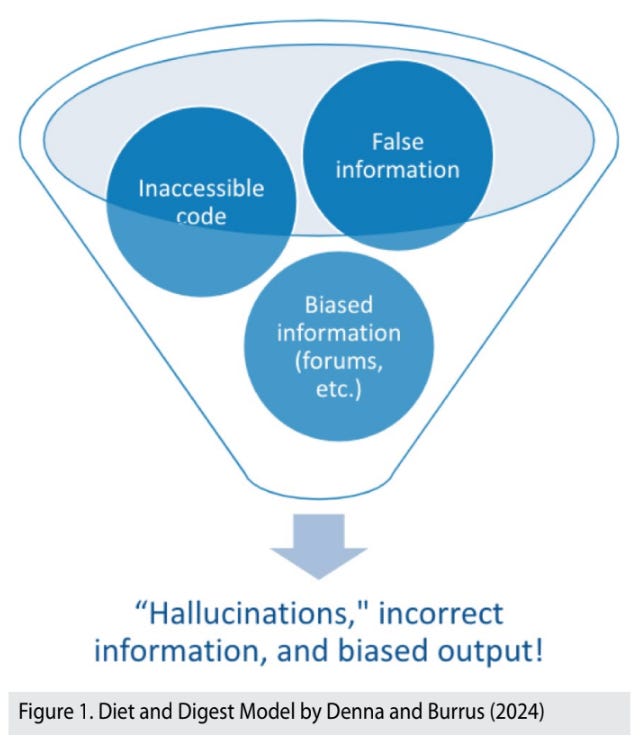
Want to know more about why AI output contains hallucinations and biased output? This diet and digest model was created to illustrate how misinformation has been used to train AI models.
Reframing the AI Conversation
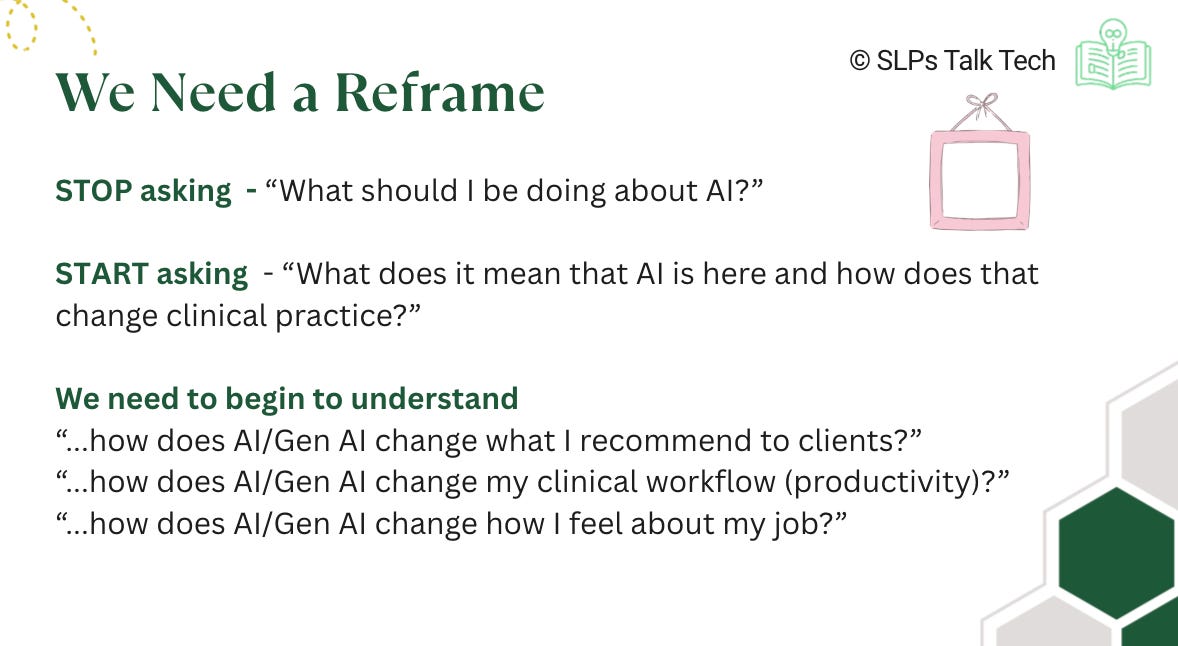
AI summaries, automated content, and generative video are saturating the digital landscape, making them increasingly difficult to ignore. Despite many people feeling exhausted by trying to keep up with AI, there is one key acknowledgement we should share: AI is getting “better”. The speed and accuracy at which AI completes tasks is improving, while underneath we continue to find negative impacts of AI’s hallucinations, bias, and false confidence. To update our priors and meet the technology where it currently stands, we need a collective reframe. It is time to stop asking, “What should I be doing about AI?” and start asking, “What does it mean that AI is here, and how does that change clinical practice?” This requires us to consider how these systems will alter key aspects of our work.
So, amidst this shift, what technology skills continue to be a part of the AI literacy conversation?
So, amidst this shift, what technology skills continue to be a part of the AI literacy conversation?
Prompting remains foundational. Your ability to interact with these tools effectively is key.
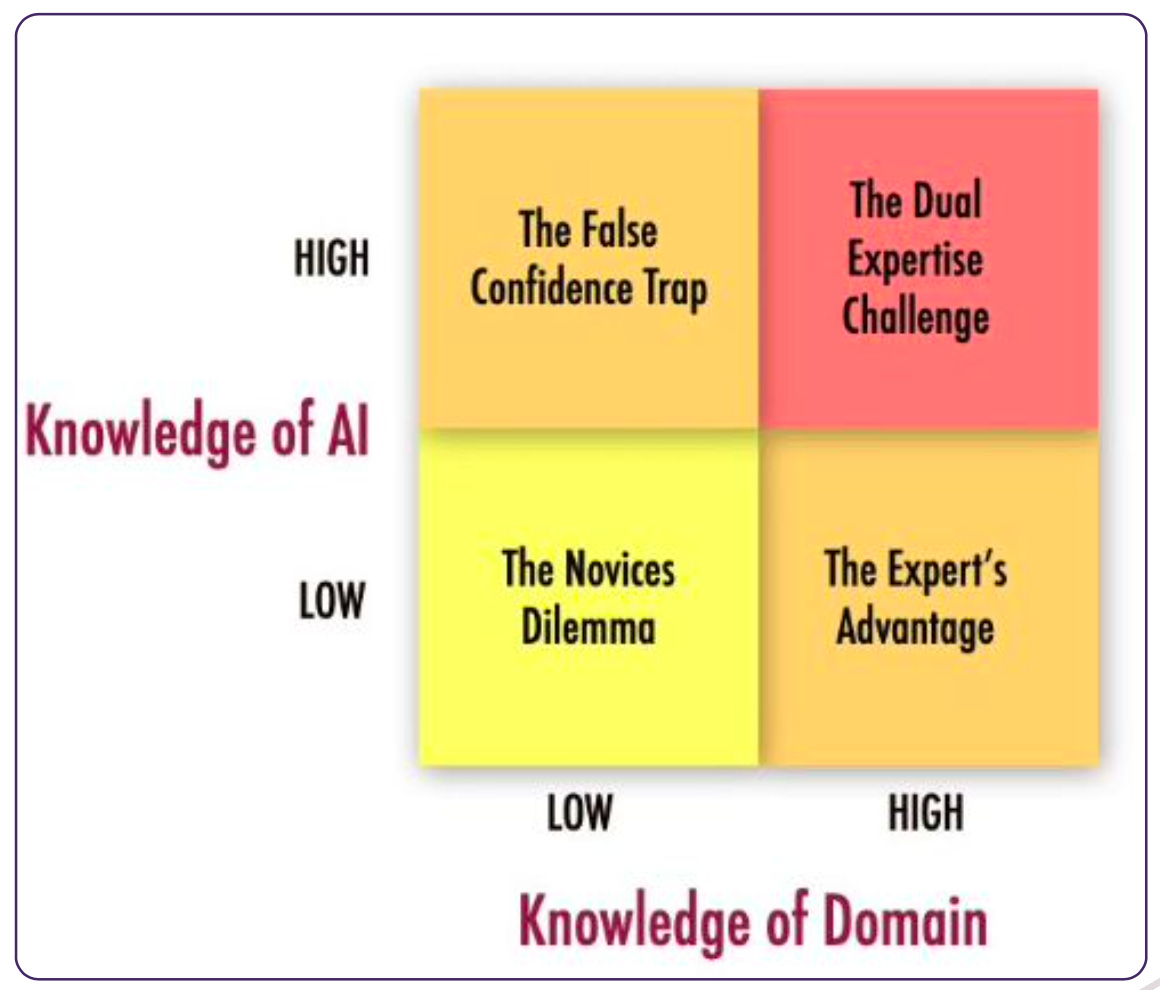
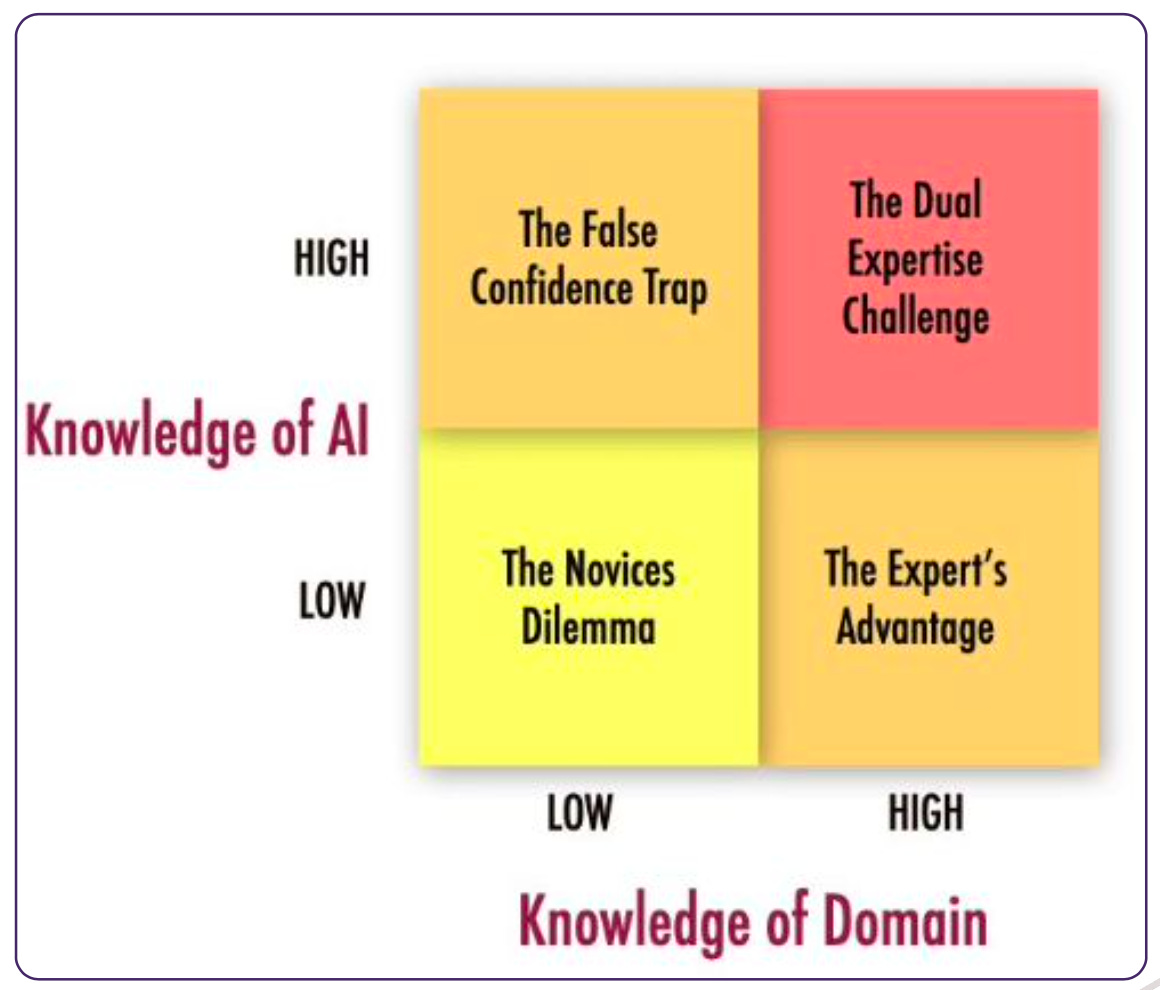
Self-reflection. Why are you using AI in the first place? Reflect on gaps in your practice and gaps in your knowledge. When using AI to augment tasks or bridge gaps in knowledge, be aware that using AI for tasks outside your domain of expertise remains the highest-risk behavior. As Punya Mishra’s Novice’s Dilemma illustrates, limited domain knowledge blinds us to AI hallucinations, making us susceptible to adopting false facts that can skew clinical decision-making.
Know the limits. Testing AI’s ability to complete tasks that actually add value to your practice and your patients is key. To understand its capability, spot false claims, and critically engage in the conversation, put AI to the test. Once you figure out what AI can and cannot do, test it again in a few months, because it’s constantly evolving.
AI Literacy. Long & Magerko defined AI literacy as a set of competencies that enables individuals to critically evaluate AI technologies; communicate and collaborate effectively with AI; and use AI as a tool online, at home, school, and in the workplace (2020). It’s important to understand that we are using generative models built on biased systems and deployed before thorough testing, a gap highlighted by research noting that even explainable AI is often not tested on humans (more below). AI literacy gives us the ability to be AI-informed, and hopefully more AI-empowered.
Explainable AI is designed to allow us to see why AI made a specific decision. However, we’re also learning that these “transparent” systems are often deployed without rigorous testing on actual humans (https://www.ll.mit.edu/news/study-finds-explainable-ai-often-isnt-tested-humans).
In the end, we are left asking: Is AI use helping us ethically close persistent gaps in our practice, or is it merely increasing the cognitive overload?In the end, we are left asking: Is AI use helping us ethically close persistent gaps in our practice, or is it merely increasing the cognitive overload?
Where can clinicians learn about AI and emerging technology research and tools?
The SLPs Talk Tech Resources Hub @ Resources.SLPsTalkTech.com offers a central repository for AI-powered and emerging technology research and tools. This curated library is specifically designed for the CSD community.
Here are some of the latest additions -
Research:
Ethical conversations: what are the implications of AI for AAC development, use, and implementation? by Nerina Scarinci, Alison Holm & Bronwyn Hemsley (2024)
Collaborating with AI, this paper identifies opportunities in AAC for persons with communication disabilities leveraging potential AI applications.
Ethical Integration of Voice Cloning Into AAC for People Living With ALS: A Living Guiding-Principles Framework by John Costello (2026)
Developed at the Jay S. Fishman ALS Augmentative Communication Program at Boston Children’s Hospital, John Costello provides a framework for clinicians considering voice cloning to enhance patient communication. Included are a step-by-step planning guide and clinical guidelines grounded in ethics for integrating voice-cloning technology into AAC.
Harnessing artificial intelligence for just-in-time AAC design for children with cortical visual impairment: a call for development and dialogue by Jamie B. Boster, Kevin Pitt & Yvette Shen (2026)
This paper proposes possible avenues for AI specifically as it relates to possible JIT programming development opportunities for children with CVI.
Tools:
Easy Report Pro
Using automation, this report writing software lets you use your customized templates and a fill-in-the-blank style report writing format to streamline evaluation writing.
📢 Share This Newsletter!
SLPs Talk Tech is free to read and share. If you find value in this work and want to help sustain it, contributions are always appreciated but never required.
Thank you for being part of this virtual space where we think critically, stay curious, and keep humans at the center of technologies that help us communicate.